1/1/16

Legal Stuff


This is boring legal stuff that applies both to my RebaKennedy.com web site as well as this blog.  Just so you know ….
.

It’s All Me.

.
I own both this web site and blog and I am the only person who contributes to them.  If you visit or shop here (should I ever sell anything here, haven't so far), then you accept the following terms and conditions.  Please read this information.
.

Texas

.
I am in Texas.  The laws of the State of Texas apply to all that I do here, and by visiting my site or my blog, you agree that the laws of the Lone Star State apply, as well, should any controversy arise between us.  
.

Disclaimer

.
I am providing information here that I think may help you because it’s helped me.  Information regarding writing, especially writing that is published on the web, and related legal issues with all that entails.

Everything provided on my web site and blog is provided on an “as is” basis, and I’m not making any representations or warranties, expressed or implied, about the operation of the site or blog or any of the information, content, or products included or referenced here.   

If you use my site or blog, then I hope you enjoy it and find it helpful to you as you simplify your life.  However, I’m not giving you any guarantees here.  By reading my site or blog, you are expressly agreeing that your use of the blog or site is in your wheelhouse and at your own risk.  I’m not your doctor, your lawyer, your therapist, your editor, or your grandma.

Insofar as all applicable law allows, I disclaim all warranties, express or implied, that this site, or its servers, or any email sent by me, is free from viruses or other evil and harmful things.  I will not be liable for any damages of any kind arising from the use of the site or the blog.

Now, as for as the substance of the stuff found on my site or blog, I research things and try to be as accurate as possible.  Still, we’re all only human and so here’s my legal lingo on this issue:
I do not represent nor do I endorse the accuracy of any of the information found on my site or blog, and this includes the information that can be found on any site or blog that is linked in my content.  
The information contained in or accessed from any hyperlinked location is out of my control and I am in no way warranting what those site owners or bloggers are doing or may have done with their stuff.  Anyone reading my site or blog acknowledges that if they rely on the stuff that they find on third party sites as hyperlinked in my content is at their sole risk. 

Privacy Policy


I do not collect information here like some other sites or bloggers choose to do, using services like FeedBlitz, for instance.  I do not provide newsletters.  I do not collect personal information and I do not have any kind of mailing list database.   If you send a comment that may have too much personal information from my perspective, then I may edit that personal stuff out of the comment before it’s published to protect your privacy. 

Using Content Found on my Site or Blog

.

1.      Copyright


All the content placed on either the website or the blog – and this means the written content as well as the graphics, images, data compilations, you get the idea, is my property.  I own it. 

It is protected by the copyright laws of the United States as well as those copyright laws established in other countries.  It’s exciting to think I have readers in other countries and therefore need to mention international copyright laws.  Love that. 

If I have released something into the public domain, then this will be clearly stated and explained in the blog post, or on the web site page. 
.

2.     Licensure


I’m fine with your personal use of the content on my web site and blog and I officially grant you the limited license to access my site and blog and read the stuff and maybe even save some of it for your own self.  That’s cool, I like the idea that some of this stuff will help you and you want to save it!

However, I have been the victim of thieves taking my stuff and then selling it as their own stuff and that’s not right.  Even worse, I’ve had scoundrels take my content and then put it into pdfs and send those puppies out to try and entice people to download those things, which are traps for their malware or other evil plans. 

So, here is the official legal lingo that points to that sort of evildoing:  I do not grant a license to anyone to take my stuff and modify it, even a part of it, unless they have my written consent on a paper document and my official pen and ink okey dokey to do so.

I do not license anyone to reproduce, copy, duplicate, sell, resell, or in any other way use or exploit for their for-profit or commercial purpose anything on either my web site or blog.  I do not license any downloading or copying of anything found on the site or blog for your own commercial use, period. 
.

Comment Policy


Comments are great.  Love them.  However, I hate spam and trolls, too.  So I have things set up so I have to approve comments before they appear on the web site or blog.  Anyone is welcome to comment, submit suggestions, reviews, ideas, new info, etc. and questions are always great. 

However, I reserve the right to edit the stuff that appears on my web site and blog.  This means that I reserve the right to omit and not publish anything submitted that is illegal, vile, obscene, threatening,  hateful, or objectionable, and this includes submissions that are or may be defamatory, invasive of someone’s privacy, possibly infringing on someone else’s copyright or trademark, or in some other way potentially harmful to third parties.

This reservation of my rights also includes the right not to publish on my site any submissions that have or may include software viruses, political stuff, advertising aka commercial solicitation, mass mailing, or other things that you might consider to be “spam.”

If I think you are using a phony email address, then I reserve my right not to publish your submission.  In fact, if I think that your submission is in misleading in any way as to your real identity and purpose, then I reserve the right not to publish it. 

As for comments that do get published, by submitting your stuff you are allowing me an irrevocable, non-exclusive, free, and perpetual, right to use that submission on my site and blog, which includes my ability to publish it, modify or change it (for instance, to remove personal information and protect your privacy), translate it, distribute it, and display the content throughout the world in any media. 

This includes the right to use your name as you submitted it with your comment.  You are warranting that the stuff you submit is your stuff, and that you own the rights to that comment’s content.  If you have been sneaky and it’s not really yours, then you will indemnify me for any and all claims that might result from your bad acts here. 

Bottom line, I cannot and do not take responsibility and I assume no legal liability for any comments or other submissions that are posted and published here that come from any third party.

Same goes for trying out any products (software, keyboards, etc.). that you read about on my site or blog.  Try this stuff and use it at your own discretion and after you’ve done your own research.  I will not be legally liable for any harm or injury suffered by someone using a product recommended or discussed on my site or blog, whatever the cause. 

Questions


If you have any questions on any of these things – or about anything else related to my web site or blog, then please feel free to get in touch with me and ask!  The current contact information will be located in the Contact information sections of the web site and blog.  (Same stuff in two places.)
.

Changing Stuff


I reserve the right to change my mind.  I may change anything on the site or blog and that includes this Legal Stuff from time to time.  (Legally, I’m reserving my right to modification.)

And if anything here (including the Legal Stuff) is found to be invalid, void, or otherwise not legally enforceable for some reason, then that specific part of the site or blog, will be severed and removed but everything else on the site and blog will not be affected and will still be cool, i.e., it remains valid and enforceable. 


11/2/15

Editing Software: Lessons From My NaNoWriMo Fever Over Online Grammar Tools

It’s time for NaNoWriMo again this year: National Novel Writing Month began a minute after midnight on Saturday night. Day 2, and I’m right on track. You betcha. If I write 1700 words each day, seven days a week for the entire month of November, I’ll meet my 50,000 word count deadline, no problem-o.

It’s fun. It’s crazy. It’s overwhelming and exciting and I highly recommend you try it if you haven’t done so before.

Word of warning. There are lots and lots of promotions that go with NaNoWriMo. Some are great: for instance, Scrivener (the writing software) can be had for a bargain this month. Then there are all those not so great deals.

I can’t tell you, Dear Reader, how many invitations have arrived in my Inbox tied to NaNoWriMo, tempting me to buy books or to purchase software aimed at writers. Oh, so enticing: “Write a Novel in a Day!” “Buy Software that Will Proofread and Finalize Your Draft in 30 Seconds!”

Even better, the package deals. That’s where they really get ya. (Writer’s Digest had a particularly interesting collection.)

Okay. Fine. Truth be told, I bought some stuff. I had the fever! I wanted to be PREPARED! I had to be RTW - Ready To Write!

I kinda went nuts on editing software. Now, before I start delving into this stuff, please know I already had editing software on my machine. Stuff I use regularly; in fact, I have used editing tools for years. YEARS. Long ago, I relied on Microsoft Word’s Spelling and Grammar tools, and I had been known to use SmartEdit occasionally as well. I think I’ve been using Natural Reader, a text to speech program, for almost a decade now (I like the voice of “Anna”).

So before this frenzy began I was already happily using Hemingway together with Natural Reader (text to speech) on my Scrivener content.


But I’m only human and that NaNoWriMo time ticker was ticking -- and I had already bought my cool new mouse pad (isn’t it GREAT?). So, over the weekend I installed After the Deadline (AFD) because it seems to work well with WordPress blogs. Grammarly is lurking on my computer somewhere, too, because I received my first weekly report card from them today. (I made an A. I’m so proud.)

All of this after checking out Ginger and several others; asking the Scrivener Community on Google Plus their preferences; and reestablishing my friendship with Microsoft Word’s Spelling and Grammar tools (after pretty much dumping Word for Scrivener).

Today I bought the premium version of ProWritingAid. It’s got a 14 day trial period, so we’ll see. 

Bottom line, I went a little nuts with editing software on the eve of NaNoWriMo. I read a couple of books on writing, too. Not that I’ve changed from being a pantser, but I like to think about outlining. 

Things to Consider When Deciding on Editing Software 


Do I need all these editing tools? No. Of course not. I have learned some lessons from trying them out, though. Here’s a couple of things about all this editing software, from me to you, Dear Reader. 

1. Editing is different for fiction and nonfiction. Most editing software targets the fiction writer. 


Hemingway, of course, targets fiction. There’s no non-fiction option with Hemingway. ProWritingAid (Premium version) offers the options of “business,” “technical,” etc., albeit nothing more specific — you won’t find “legal” or “medical” there. If there are editing packages targeting those niches, I didn’t find them.

2. Most of these options are web-based. You cannot download the software, you have to insert your content into their website and hit the button. 


I don’t like it. I want the software on my machine (one of the reasons I like Hemingway). Sure, downloading any program is scary because of the threat of malware, but a quick scan of the file by your anti-virus before installation should protect your machine.

I’ve got two reasons that I prefer to have the software on my machine.

First, I can use it without accessing the web. I don’t like being forced to go online to edit some content. Second, I don’t like having to paste my content into a window on a webpage and crossing my fingers that they’re being honest about not keeping my stuff and not sharing it.

3. Most of these editing tools do not differentiate between grammar, style, and usage. These are three different things, people. 


When your edit appears in the software, don’t be surprised to see a rainbow of colors staring back at you. These are not all grammar errors. You didn’t forget how to write. You write well. Look carefully — if you’re like me, what you’ll find are issues of style and usage, not grammar. This can be very, very frustrating.

For more on this, read Michael McDonagh’s post “Grammar, Style, and Usage are Three Different Things.“ 

4. These editors apparently find some of my favorite writers are in desperate need of help, as well. 


I love how Peggy Noonan writes. Politics or religion aside, check out her alliteration. Sigh. If you paste one of Noonan’s columns into Hemingway or ProWritingAid, you’ll get a rainbow reaction.

Ditto for Sharyl Attkisson. Or the Miami Herald’s Dave Barry (oh, how I love how Dave Barry writes).

Apparently, all the writers I love tend to use long sentences. They will scatter the passive voice into their stuff. Occasionally, they will use (wait for it) an adverb!

Sometimes, the grade level of the reader is estimated to be at a high school level, but they may get to grade level 12 or 15 on occasion (and I’m looking at you, Sharyl Attkisson).

5. Take these editors with a grain, Dear Reader.  These are tools.  Not professional proofreaders. Don't take these edits as commentary on the quality of your writing. 


I suggest that you take some content of your favorite writers and use it to test the editing software you are contemplating using.

For one thing, you’ll get a good laugh or two. For another, you may find as I did, that you may not write exactly like your writing role models, but it’s encouraging to find that in the Editing Software World, you are making their same errors.

Makes you feel like you’re in the same club or something.

And it helps you remember that these editing software gizmos are tools. Just tools.

Spelling and Oxford Commas are one thing. Style is another. Usage, too. Shake your head and move on.
.

10/5/15

Fair Use and Copyright Infringement: The 2015 Dancing Baby Case and You, Dear Reader

There’s been lots of discussion about a recent Fair Use case that has come down from the United States Court of Appeals for the Ninth Circuit, Lenz v. Universal Music Corp., No. 13-16106 (9th Cir. Sept. 14, 2015).  Forbes, for example, lets its readers know that from this new court opinion, “[i]f a copyright holder ignores or neglects our unequivocal holding that it must consider fair use before sending a takedown notification, it is liable for damages.”
.

Here’s what you need to know, Dear Reader, regarding “fair use” and “copyright infringement” now that the Dancing Baby Case opinion has been published.

.
.

The Dancing Baby YouTube Video: Mommy Files a Lawsuit


Maybe you’ve heard of the "Dancing Baby Case."  Long ago, on February 7, 2007, Stephanie Lenz  sat down at her computer.  She went to the YouTube website and uploaded a 29-second personal video she had made of her two little kids dancing in the kitchen to Prince’s song, “Let’s Go Crazy.”  She shared the video on YouTube with anyone that wanted to see it.  

She named the video of her babies dancing in the kitchen, “Let’s Go Crazy.” In the video, early on, she asks her toddler son “what do think of the music?” and he responds by bouncing up and down.  

Meanwhile, over at Universal, a man named Sean Johnson had the full-time job of monitoring videos that were uploaded to YouTube for copyright infringement of Universal’s artists.  Among Universal’s artists was Prince, and it was Universal’s job to enforce and protect Prince’s song copyrights.

Sean Johnson was Universal’s man on the scene; employed an assistant in their legal department who every day went to the YouTube website to search for uploads of Prince’s music.  If that search came back with search results for a Prince song, then he would watch the video on YouTube.  

He made the initial call on whether or not the video "embodied a Prince composition" by making “significant use of . . . the composition, specifically if the song was recognizable, was in a significant portion of the video or was the focus of the  video."  If he found something objectionable, he would share it with others at Universal.  Universal would then notify YouTube that the video should be taken down as a copyright violation if Universal believed the “composition was the focus.”

In the Universal review process, Stephanie Lenz’s home video of her kids dancing in the kitchen to a Prince song was considered to meet their criteria. YouTube was notified by Universal to take the Dancing Baby Video down.  YouTube did.

Result?  Mommy Stephanie Lenz filed suit under the Digital Millennium Copyright Act ("DMCA") section 17 U.S.C. § 512(f), arguing that Universal misrepresented in its takedown notification that her 29-second video was an infringing use of Prince’s work. 

What the Lenz case holds:

“Her claim boils down to a question of whether copyright holders have been abusing the extrajudicial takedown procedures provided for in the DMCA by declining to first evaluate whether the content qualifies as fair use. We hold that the statute requires copyright holders to consider fair use before sending a takedown notification, and that failure to do so raises a triable issue as to whether the copyright holder formed a subjective good faith belief that the use was not authorized by law. We affirm the denial of the parties' cross-motions for summary judgment.”

The Dancing Baby Case and You, Dear Reader


It’s an important case for you, Dear Reader, no matter which side of the copyright you’re on:   whether you are a writer, photographer, or designer trying to protect your copyright, or you are a blogger or ebook author who wants to use an excerpt or image that may be protected by copyright law.  

Here are some things for you to know:

Lenz Is Not the End of the Road on Fair Use


1.  This is a recent federal appeals court decision in a fight that lasted 7 years.  It’s a big deal.  

The only higher court than a federal appeals court is the United States Supreme Court.  Whether or not this case will be appealed to the High Court is one question (actually, a petition for writ would be filed).  

First, they may request a full  hearing of all the justices in the Ninth Circuit in what’s called a “motion for rehearing en banc.”  If the motion is filed and it’s granted, the whole case gets reconsidered by all the justices on the Ninth Circuit, not just the ones that were assigned to hear the case and who issued this opinion.  

Even if the losing party in this case wants SCOTUS to review the Ninth Circuit decision, and can do so after the rehearing motion, odds are not in their favor.  First, SCOTUS only agrees to hear a handful of cases that request review.  Second, a review is no guarantee that things would go their way; they could lose again.  

My point:  this opinion isn't quite jelled yet, it could change.  Lawyers know that the odds aren't high that a rehearing is going to change things (if it were granted), so many read the current opinion as speaking for the Ninth Circuit.  And the odds are even more remote that SCOTUS is going to change things, and even if it did, this opinion will be good law in the Ninth Circuit until it does.  

So, Lenz is probably going to become finalized law ... unless it's not after additional review.  There is a remote chance that this fight isn't over.  


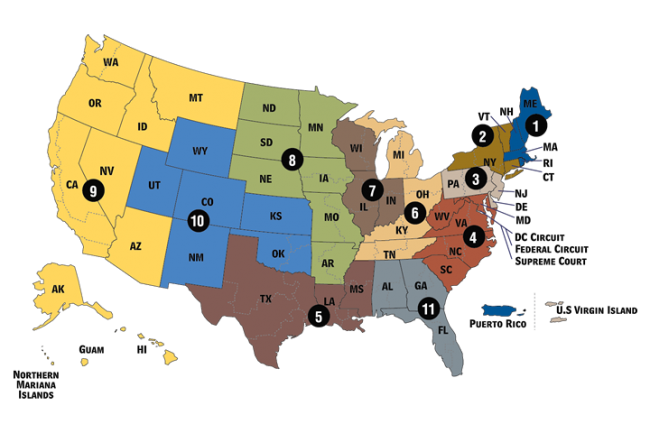
2.  This is a decision out of the Ninth Circuit.  There are several regions, or circuits, in the United States.  Texas, for instance, sits in the Fifth Circuit.  

Each federal court of appeals in each federal circuit has the independent authority of reviewing cases that come before it within its jurisdiction.  These independent reviews may or may not agree, or jive.  In fact, controversies and opposite rulings in different federal circuits are often the reason that SCOTUS does grant writ and take review: to make the final call when two or more circuits don’t agree on the answer to a legal question or issue.

My point:  Lenz may or may not be final law for the Ninth Circuit (yet).  Once it’s final, it may be considered as a respected federal court decision by everyone in this country.  But it’s not the end of the road on this issue.  If a similar case were to be heard before the Fifth Circuit, for instance, would that court answer in the same way?  We don’t know.   It’s possible for a similar case to be heard in another circuit (YOUR circuit) and that circuit rule opposite from the Ninth Circuit in Lenz.  

Lenz Doesn’t Answer Every Question on Fair Use


3.  Another point.  Lenz is not a case with clear cut answers for everyone.  Within Lenz, issues are left unclear and not every question is answered.  Lots of lawyers are chatting with each other about what all Lenz will mean in future copyright infringement cases.  For instance:


  • Is “fair use” a particular type of affirmative defense or is it not an affirmative defense at all?
  • What exactly does this mean for those companies that sent out those robotic, automated takedown requests in bulk? 
  • If someone wants to send a takedown notice, then they have to consider fair use — but Lenz explains the “…copyright holder’s consideration of fair use need not be searching or intensive.”  So, how does a copyright holder establish in evidence that they considered fair use before they send their notice?  Is simply saying “I considered the fair use doctrine in this situation and determined it didn’t apply” going to be enough? 


4.  What we do know from Lenz (this isn’t an exhaustive list):


  • If you are going to send someone a takedown request under Section 512(c), then you have to consider Fair Use;
  • Deciding if something is a knowing misrepresentation is done by a subjective (not objective) standard;
  • No damages are available for “impairment of … speech rights” but nominal damages are available to plaintiffs suing under Section 512.


The Dancing Baby Case and You


What does this mean to you, Dear Reader?  

Well, we have a federal appeals court decision on the books now that helps people who want to argue they have a fair use right to use someone else’s work without it being copyright infringement.  It should make humans check the work of their robots before they automatically demand a takedown. 

Given the current state of web publication (including social media), there’s a lot of grabbing of content and images (ESPECIALLY IMAGES) and this case helps those people.  The people using the stuff.  Arguably.  

But Lenz is muddy water.  So, while the Dancing Baby Case is getting lots of attention (and kudos to the Electronic Frontier Foundation (EFF) for all their hard work here), this case isn’t something that provides an easy guide to the people out there who own copyrights or those who want to use stuff they find on the web that is copyrighted.  

The reality remains that there’s a lot of copyright infringement going on right now, and at the same time, there’s a lot of bullying of nice and decent people who have a fair use right to use an image or other work.  There are good guys and bad guys on both sides of the issue:  using stuff fairly and infringing on copyrights wrongfully.  

And Universal was challenged for not considering "fair use" before sending YouTube that takedown notice.  But if Universal had stated, "we considered fair use and found it lacking here," then would they have met Lenz's standard?  

Will Lenz really work to block bullies from blocking fair use through manipulation of DCMA takedown notices?  

Bottom line:  You need to ask a lawyer if you have a question in your particular circumstance.  Copyright infringement and fair use remain complicated legal issues, and Lenz does NOT make things clear.   

For more, read:

Big, Confusing Mess Of A Fair Use Decision Over DMCA Takedowns at Techdirt.